
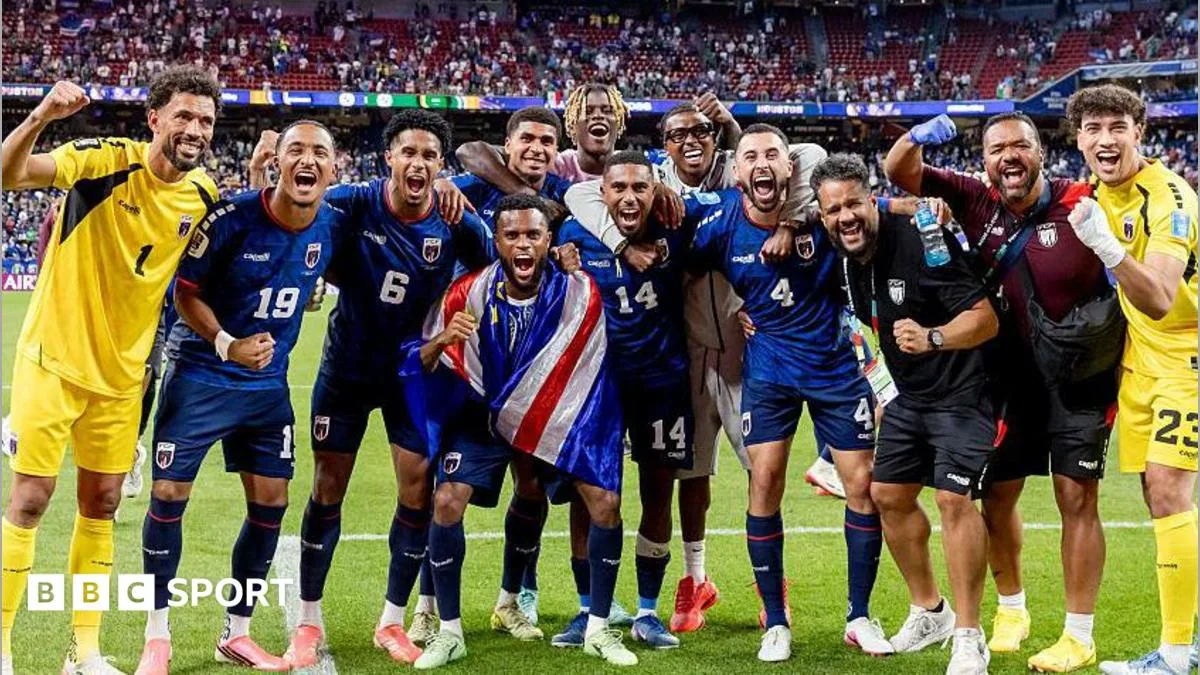

Cape Verde has achieved a historic milestone by becoming the smallest nation to advance to the knockout stage of the World Cup. The team, representing a group of 10 islands in the Atlantic Ocean, will now face defending champions Argentina in the last 32.
Following their goalless draw with Saudi Arabia, players gathered on the pitch, watching a mobile phone for the final moments of Spain’s victory over Uruguay. This result confirmed Cape Verde as Group H runners-up, sparking emotional celebrations among the team and fans.
BBC Radio 5 Live commentator Rob Law, present in Houston, described the scene as filled with “tears of pride and joy.” He noted the “beautiful moment” when the team huddled together, awaiting the final whistle that confirmed their progression, calling it “the moment of the World Cup so far.”
This achievement follows an impressive run in the group stage, which included a goalless draw against Spain, where 40-year-old goalkeeper Vozinha was a key performer, and a 2-2 draw with two-time World Cup winners Uruguay. Juan Mata, a former World Cup winner for Spain, commented on ITV that it was “incredible what they are doing,” highlighting their consistent performance at a high level across three games.
The diaspora factor and a long-term plan
The success of the Blue Sharks is largely attributed to the Cape Verde’s football federation’s (FCF) strategy of recruiting players from the country’s diaspora. Historical emigration, particularly to Portugal due to severe droughts and a strong seafaring tradition, has led to a significant population with Cape Verdean roots in places like Rotterdam.
Of their 26-man World Cup squad, fourteen players were born abroad, with six originating from the Dutch port city. One such player, forward Dailon Livramento, who played for Casa Pia in Portugal’s Primeira Liga last season, scored the crucial goal in their qualifying win against Cameroon last September.
Josina Freitas Fortes, a member of Cape Verde’s parliament, told BBC Sport Africa that the FCF has made substantial progress through “passion, commitment and a clear technical plan.” She added that the results are a product of “years of consistent work, strong belief and people who have given their heart to the project.”
A notable example of this recruitment strategy is the inclusion of Dublin-born centre-back Roberto Lopes, who was identified via LinkedIn in 2019. Former Manchester United winger Bebe also featured in their 2023 Africa Cup of Nations (Afcon) squad, having previously represented Portugal at under-21 level.
Lopes expressed the team’s belief, stating, “There is an inner confidence in this team that we are good enough to mix with the best teams in the world.” He further explained that this confidence is not new, but part of “an ongoing plan to get Cape Verde up at the big table with the big football nations of the world.”
Coaching stability and team identity
Much of the credit for Cape Verde’s performance is given to coach Bubista, a former international player who has been in charge since January 2020. His stable leadership has fostered a compact and well-drilled side known for its organised defence, technical midfielders, and gifted forwards.
Under Bubista’s guidance, the team upset Ghana and drew with Egypt during their run to the quarter-finals at Afcon 2023, a tournament they debuted in only 10 years prior. The team’s discipline was evident in their goalless draw against the 2010 champions Spain, where they conceded only one foul, the fewest recorded by a team in a World Cup match since 1966.
Defender Sidny Lopes Cabral told the BBC World Service, “We always train and play as one unit, so everything we did in the game was not our first time that we did it.” He added, “For us, it’s our game. This is how we play, this is who we are. This is our personality as a team and as defenders.”
In their second Group H match against Uruguay, Cape Verde adopted a more attacking approach. Bubista emphasised the importance of showing their “identity as a team, our strength, our unity, and also our resilience.”
Bubista had previously expressed confidence in his team’s potential, telling BBC Sport Africa before the 2021 Afcon, “I think in the future we’ll be at the World Cup.” His prediction has now come true, and he hopes Cape Verde’s success at the expanded tournament will inspire other underdogs globally, believing that “football belongs to everyone, or is for everyone.”
Facing the champions
Cape Verde’s reward for their historic progression is a match against Lionel Messi’s Argentina in Miami in the last 32 on Friday. Midfielder Deroy Duarte, who was named man of the match against Saudi Arabia, described the feeling as “mad” and like being “in a dream.”
Duarte expressed his excitement, stating, “First, let’s celebrate. We’re so happy. Let’s hope all Cape Verdeans are happy too. From tomorrow, we’ll focus on the next match.” He acknowledged the challenge, saying, “It’s against Argentina, isn’t it? A tough match, but let’s believe. Anything is possible.”
Former Tottenham, Nottingham Forest, Celtic, and Australia boss Ange Postecoglou commented on ITV that it is “just a great story for what the World Cup is all about.” He highlighted how football connects globally, and this achievement “just adds to their story. Playing against the reigning champions. What a great story it’s been.”
Former England and Manchester United defender Gary Neville suggested that those who were sceptical about expanding the World Cup might be reconsidering their views after witnessing the enthusiasm of Cape Verde fans. He noted, “A country of 500,000 people getting to the knockout phase. We’ve seen Uruguay, one of the biggest countries, going out and then one of the smallest teams making it. What a moment for them.”
Cape Verde, ranked 67th in Fifa’s rankings, has gained many new supporters on this journey, reminding many of the joy that football can bring. They are the first African debutants to advance from the World Cup group stage since Ghana in 2006.
Read Also
Source: bbc.com

Niamh Pendlebury is the Sports Reporter at NewsGB.org, covering tennis, cricket and athletics with seven years of reporting experience. She reported on Team GB and the county circuit. She holds a degree in Sport and Media from the University of Central Lancashire and completed an NCTJ diploma. Based in Preston, she plays club tennis and follows road running. “The best interviews come from patience, not pressure.”