

Mikel Merino, a key player for Spain, has spoken about his approach to football, emphasising the importance of being a good person before being a good footballer. His comments come as Spain prepares for the World Cup final against Argentina in New Jersey’s MetLife Stadium.
Merino reflected on a significant year, describing it as “spectacular.” He mentioned achieving a Premier League title, reaching a Champions League final, the birth of his first child, and now participating in a World Cup final. These accomplishments followed a period where a stress fracture in his foot threatened his participation in the World Cup.
The 30-year-old admitted that he did not expect to be at the World Cup after learning about his injury. He underwent surgery at the end of January, which provided some clarity. He spent two months on crutches before beginning his recovery. Despite playing only 28 minutes between January and the World Cup, he expressed immense joy at being part of the team, especially after leaving his newborn son, Marco, behind.
Impact from the bench
Merino has made a notable impact for Spain, often coming on as a substitute. He scored a goal against Germany that advanced Spain into the semi-finals. He also scored against Portugal, contributing to Spain’s progression to the quarter-finals. Subsequently, he scored another winner against Belgium. These goals were celebrated in a distinctive manner, circling the corner flag as his father, Ángel Miguel, had done years earlier for Osasuna.
He acknowledged that coming off the bench is not ideal for any player, but stressed the importance of valuing every opportunity within a strong national team. Merino stated his belief in his ability to impact the game whenever he steps onto the pitch. He hopes that any Spanish player can be the hero in the final, viewing the trophy as belonging to the entire team, not just the starting eleven.
Merino also discussed the balance between ego and humility in football. He noted that players arriving at the national team, often important figures at their clubs, encounter a new dynamic. He credited coach Luis de la Fuente and the squad for fostering an environment focused on being good humans first, which helps in spending extended periods together. The team’s strength, he believes, comes from their deep understanding of each other.

Team cohesion and tactical approach
The team’s strong bond is evident in their off-field activities, with some players engaging in games like PlayStation, Mario Kart, or chess. Merino, however, prefers “sobremesa” – long conversations after meals, discussing life, family, and future plans. This collective spirit has deep roots, built on respect and a long history together.
De la Fuente has coached many of the current squad members at junior levels, including Merino and Rodri, who were part of the European Under-19s winning team in 2015. This long-standing relationship means the coach understands each player’s capabilities, and the players, in turn, have complete faith in him.
This strong foundation has contributed to Spain’s success under De la Fuente. Since an early loss in his tenure, Spain has lost only once in 37 games, which was on penalties in a Nations League final. They have since won a Nations League and a Euros, now reaching the World Cup final.
In their 2-0 World Cup semi-final win against France, Spain demonstrated a tactical approach involving passing triangles. This strategy created options for Spain and uncertainty for their opponents, forcing French defenders to make choices. The effectiveness of these triangles lies in their ability to control when and where space appears on the pitch.
The geometry of play is not just about static positions but also about timing and movement. A pass is effective if the ball reaches the receiver before an opponent can intercept. Pedro Porro’s 58th-minute semi-final goal against France exemplified this, as his movement created a new angle after exchanging passes with Dani Olmo.
The speed with which Spain reconfigures its attacking shapes makes it challenging for opponents to reorganise. This tactical advantage, where triangles preserve alternatives and create space, is expected to play a significant role in the upcoming World Cup final against Argentina.
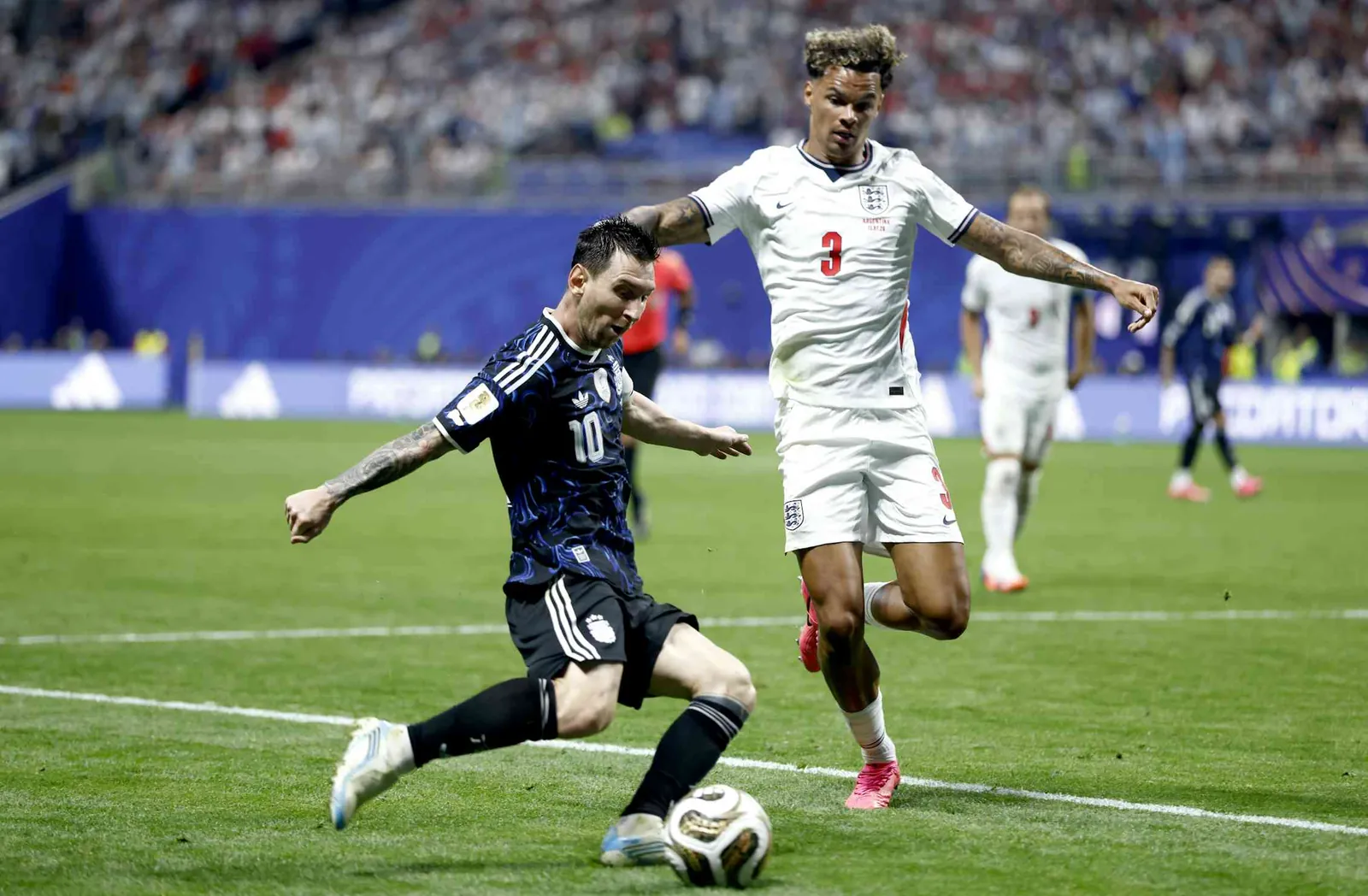
The World Cup final between Spain and Argentina is scheduled for Sunday in New Jersey.
Read Also
- Royal Birkdale: Bryson DeChambeau given two-shot penalty at Open Championship
- England coach Thomas Tuchel delivers message to players after World Cup semi-final exit
- Aston Villa Secures Johan Manzambi in Club-Record Deal
- Donald Trump questions Harry Kane's defensive role for England after World Cup semi-final exit
Source: theguardian.com

As NewsGB.org's Sports News Writer, Theo Marsden reports on rugby union, golf and boxing for readers across the country. He began on a regional sports desk in Yorkshire. He holds a degree in Journalism from the University of Hull and completed an NCTJ diploma. Theo lives in Hull, where he follows the European Tour and amateur rugby. “Sport moves fast; readers deserve it right the first time.”